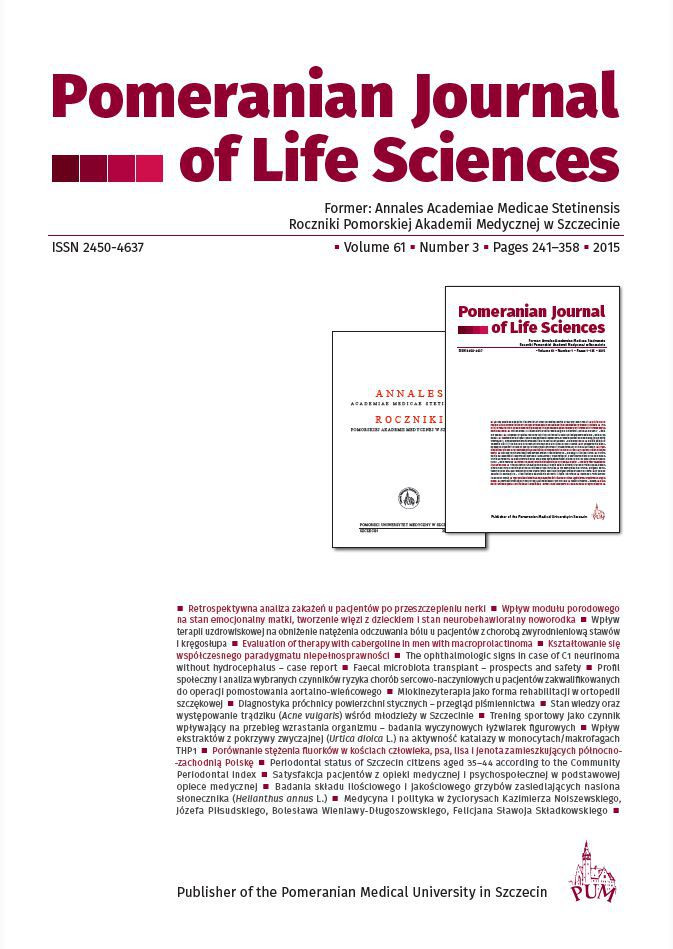
The influence of stinging nettle (Urtica dioica L.) extracts on the activity of catalase in THP1 monocytes/macrophages
DOI:
https://doi.org/10.21164/pomjlifesci.129Keywords:
owocostany pokrzywy, komórki ludzkie, katalazaAbstract
Introduction: Stinging nettle (Urtica dioica L.) is one of the most valuable plants used in phytotherapy. The herbal raw material is a herb (Urticae herba), leaves (Urticae folium), roots (Urticae radix) and seeds (Urticae semina). This plant is a good source of vitamins, minerals, fibre, protein and biologically active compounds with antioxidant properties. The literature provides limited information about the chemical composition and properties of the seed heads. No papers are available on the effect of extracts of this plant on catalase activity in human cells. The aim of this study was to investigate the impact of stinging nettle (Urtica dioica L.) extracts on the antioxidant activity of catalase in THP1 macrophages.
Material and methods: Two types of extracts: water and alcohol, at two different concentrations, were used in experiments. Nettle was collected in September and October in 2012 in the area of Szczecin. The collected plant material was frozen and lyophilized. After those procedures water and alcohol extracts of nettle were prepared and then added to THP1 cells.
Results and conclusions: The antioxidant activity of catalase was established with the spectrophotometric method. The study showed that both extracts (water and alcohol) significantly increased the antioxidant activity of catalase in THP1 cells. The increase in catalase was directly proportional to the concentration of the added alcohol extract
Downloads
References
Grau J., Jung R., Münker B.: Leksykon przyrodniczy. Zioła i owoce leśne. Świat Książki, Warszawa 1996.
Nartowska J.: Pokrzywa zwyczajna. Panacea. 2007, 3 (20), 6–9.
Pieszak M., Mikołajczak P.Ł.: Właściwości lecznicze pokrzywy zwyczajnej (Urtica dioica L.). Post Fitoter. 2010, 4, 199–204.
Bisht S., Bhandari S., Bisht N.S.: Urtica dioica (L): an undervalued, economically important plant. Agric Sci Res J. 2012, 2 (5), 250–252.
Różański H.: Pokrzywa – Urtica w fitoterapii. http://www.luskiewnik.pl/ urtica/opis.htm (26.11.2013).
Činčura F., Ferákowá V., Májovský J., Šomšák L., Záborský J.: Pospolite rośliny środkowej Europy. Państwowe Wyd. Rolnicze i Leśne, Warszawa 1990.
Górnicka J.: Apteka natury. Poradnik zdrowia. AWM, Warszawa 2003.
Nowak R.: Natura – niedoceniane źródło kwasu askorbinowego. Post Fitoter. 2004, 1, 14–18.
Bonenberg K.: Rośliny użyteczne człowiekowi. Instytut Wyd. Związków Zawodowych, Warszawa 1988.
Gumowska I.: Ziółka i my. Wyd. PTTK „Kraj”, Warszawa 1983.
Uluata S., Özdemir N.: Antioxidant activities and oxidative stabilities of some unconventional oilseeds. J Am Oil Chem Soc. 2012, 89 (4), 551–559.
Krauze‑Baranowska M.: Pokrzywa leczy. Panacea. 2005, 3 (12), 27–28.
Sroka Z., Gamian A., Cisowski W.: Niskocząsteczkowe związki przeciwutleniające pochodzenia naturalnego. Postępy Hig Med Dośw. 2005, 59, 34–41.
Augustyniak A., Skrzydlewska E.: Zdolności antyoksydacyjne w starzejącym się organizmie. Postępy Hig Med Dośw. 2004, 58, 194–201.
Chrubasik J.E., Roufogalis B.D., Wagner H., Chrubasik S.A.: A comprehensive on nettle effect and efficacy profiles. Part I: Herba Urticae. Phytomedicine. 2007, 14 (6), 423–435.
Gałecka E., Jacewicz R., Mrowicka M., Florkowski A., Gałecki P.: Enzymy antyoksydacyjne – budowa, właściwości, funkcje. Pol Merkur Lekarski. 2008, 25 (147), 266–268.
Skólmowska M., Kmieć M.: Enzymosomy antyoksydacyjne – właściwości i zastosowanie. Postępy Hig Med Dośw. 2011, 65, 640–644.
Bradford M.M.: A rapid and sensitive method for the quantitation of microgram quantities of protein utilizing the principle of protein‑dye binding. Anal Biochem. 1976, 72, 248–254.
Aebi H., Suter H., Feinstein R.N.: Activity and stability of catalase in blood and tissues of normal and acatalasemic mice. Biochem Genet. 1968, 2 (3), 245–251.
Vives‑Bauza C., Starkov A., Garcia‑Arumi E.: Measurements of the antioxidant enzyme activities of superoxide dismutase, catalase, and glutathione
peroxidase. Methods Cell Biol. 2007, 80 (19), 389–391.
Wadhwani T., Desai K., Patel D., Lawani D., Bahaley P., Joshi P. et al.: Effect of various solvents on bacterial growth in context of determining MIC of various antimicrobials. Int J Microbiol. 2008, 7 (1), 1–6.